PRIORITIZING OUR PATIENTS & THE DOCTORS WHO TAKE CARE OF THEM.
Who we are.
We are attending doctors across the University of California taking back control of our working conditions in a system where profitability has increasingly been prioritized over the needs of patients and the doctors who care for them.
We are organizing to advocate for the highest standards of care for our patients and reclaiming our power as doctors.
By joining forces with two SEIU local unions, CIR-SEIU and Doctors Council SEIU, we aim to transform the patient-doctor experience and create generational change by organizing the medical career path: from medical students, interns, residents and fellows, to attendings.
Why we are organizing.
We are fed up with a corporatized healthcare system that leaves us powerless, overworked, and disrespected, dictating our schedules and burdening us with administrative tasks while taking away our time from patients, research and teaching, resulting in doctor burnout.
We want to save our profession, reclaiming our agency, respect and a seat at the table.
It’s time to set our own priorities and advocate for ourselves, protect our colleagues, and provide the best care possible.
We’re building a union by and for physicians!
The SEIU Difference
Why Doctors United?
As UC attending doctors, we are fighting to save our profession and to change the future of medicine in California.
We want to set our own priorities, advocate for ourselves, protect our colleagues, and provide the best care possible for our patients and communities.
- A union by and for doctors is the best way to fight for our priorities and our own contract.
- Protect our roles and responsibilities not shared with other healthcare professionals.
- We’re organizing our union in order to save our profession and protect our patients, creating an organizing path from med students to interns, residents, fellows and attendings.
- CIR doctors are ready to share their experience winning strong UC contracts.
- We have the support and political strength of more than 540,000 unionized doctors, nurses and healthcare professionals in the UC system, and the rest of California, and 1.2 million SEIU Healthcare members nationwide.
The Union Difference
Doctors in SEIU have won important victories across the country! Attending SEIU doctors have experience organizing new units and bargaining strong new contracts, as well as successor contracts.
This is just a sample of major wins by attending SEIU doctors across the country:
In the UC System:
- 16.8% total raises for the current CIR contract
- $1000 backpay in 2025
- 8 weeks of parental leave
- $30,000 in fertility, healthcare benefits, and wage increases
- Meal benefits at UCLA and UCSD
- Safe rides home at UCLA and UCSF
- 8% wage increase at UCSD in 2024
In California:
- Expanded fertility treatments through AB729
- Removing mental health disclosures on licensing applications
- Due process in the UCs through legislation
- $25 minimum wage for all healthcare workers, benefiting UCR and UCSF-Fresno residents
- Mandatory 90-day state and hospital-level PPE supply for essential workers
Economic benefits:
- NYC Health and Hospitals (NY, Doctors Council): $12 million compensation pool for market-rate salary increases, standardized pay rates for comparable positions, yearly productivity bonuses negotiated by the doctor’s union and the employer, and Faculty Practice Plan and right to bargain over distribution of yearly bonuses. Went from zero parental leave to 4 weeks of parental leave. Union members receive both a pension and health coverage in retirement from the City of New York. Correctional Health Services doctors won a 40-hour work week and yearly $200 stipend for lab coats.
- Allina Health (MN, Doctors Council): Went from zero hours of paid time off to 288 hours for all doctors who work half-time or more.
- Cook County Health (IL, Doctors Council): Recent 1-year contract extension agreement with 8% raise, $2,500 bonus, and gains in extra duty pay and pay equity.
- Rutgers (NJ, Doctors Council): Guaranteed minimum 14% salary increase over most recent 4-year contract, Peer Evaluation Committee to recommend amounts for merit-based increases, and $3,000 salary increase through the bump-up clause.
- Regional Center-East Bay (CA, SEIU 1021): Immediate 8% COLA increase, followed by 2% COLAs annually.
- Alameda Health System (CA, SEIU 1021): All wages increased by 3% each year of contract.
- La Clinica de la Raza (CA, SEIU 1021): A 2.5% longevity bonus for doctors with 25 years of continuous service to recognize continued service and experience. Employer pays for hospital privilege fees, and DEA registration fees.
- ChristianaCare (DE, Doctors Council): Private lactation rooms, lactation breaks counted toward annual productivity standards and time worked.
- Multiple hospitals: Access to fertility treatments through their healthcare, increases in CME reimbursement, and parking benefits.
Doctor voice and fairness:
- Alameda Health System (CA, SEIU 1021): Strong safety protections including: no retaliation for raising safety issues, representation on safety committees, orientation and safety trainings, and being provided Cal/OSHA logs annually.
- Allina Health (MN, Doctors Council): Doctors won the right to refuse an assignment if not deemed as safe.
- Multiple hospitals: Guaranteed Labor Management Meetings and Collaboration Councils in which doctors and management periodically meet to discuss and solve workplace issues, and a fair process to solve problems and ensure just discipline, with a neutral arbitrator (not administration) to make final decisions.
Patient care
- Mary’s Center (DC, SEIU 1199): Workload caps of no more than 4 patients per hour, and 25 patients per day.
- Rutgers (NJ, Doctors Council): Staffing and scheduling protections to help reduce instability in patient care coverage and continuity.
- NYC Health and Hospitals (NY, Doctors Council): 120% increase in utilization of the Palliative Care Program and protected labor and delivery services from cuts.
These are just some of the priorities union members have won by fighting collectively. By building our doctors union, we are the ones deciding our priorities.
What would you like to win?
It’s our union. Get involved!
Here’s how you can contribute to a stronger union:
- Get your colleagues in your department and your friends in other specialties to sign up
- Get involved by joining the Organizing Committee
- Identify leaders within your specialty and other specialties you work with and get them involved
Endorsements
Endorsing Organizations
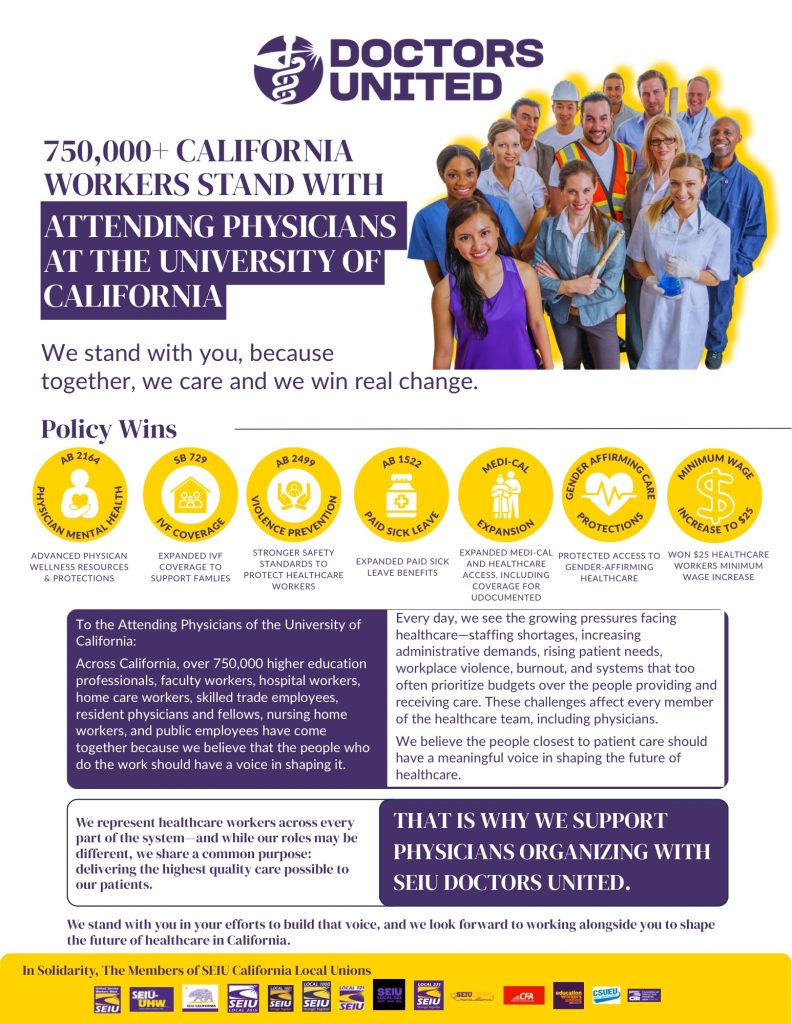
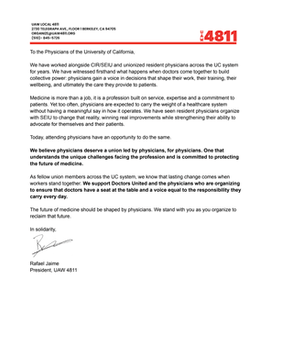
- UAW Local 4811
- California Nurses Association
- California Faculty Association
- Committee of Interns and Residents SEIU Healthcare
- SEIU 2015
- SEIU 1021
- SEIU-UHW United Healthcare Workers West
- CSUEU CSEA / SEIU Local 2579
- SEIU 221
- SEIU 121 RN Nurse Alliance
- SEIU 721
- SEIU Local 521
- SEIU California
- SEIU United Service Workers West
- Education Workers United SEIU Local 99
Letters – click to read:
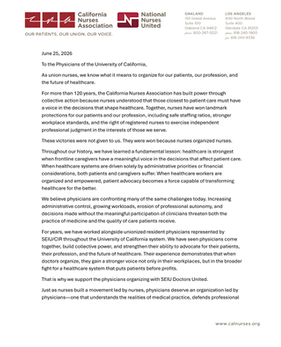
What We Are Fighting For
- We want to restore agency, respect and power to doctors so we can provide the best care we can
- A workload that allows us to care for our patients, conduct groundbreaking research, and teach our interns and residents how to practice medicine the right way
- A health system that prioritizes investing in care
- Putting an end to doctor burnout
- Fair and equitable compensation that attracts and retains the best doctors
- Protecting our peer-review system and academic freedom
- Having a seat at the table to participate in the decisions affecting our work and our lives
- An end to the emergency room crises that are impacting care for all Californians
These are just some of the issues raised by our colleagues. We want to hear from you. Reach out to us and let us know what YOU want to fix at UC.
FAQs
Are doctors even eligible to unionize?
As medicine becomes more corporatized, an increasing number of doctors are considered employees and are joining together in unions to reclaim our power to advocate for ourselves and our patients.
Employment circumstances vary and may affect a doctor’s eligibility to unionize.
Who is Doctors United?
SEIU Doctors United is the largest and fastest-growing doctors’ movement, representing over 43,000 housestaff and attendings from SEIU-CIR and Doctors Council-SEIU. This doctor-led organization fights medical corporatization, improves patient care and access, and enhances jobs. We collaborate with public health systems, leveraging the one-million-strong SEIU Healthcare for quality jobs and universal care.
What are the benefits of forming a union?
By forming a union like the residents, attendings can collectively bargain for a legally-binding contract with the UC. This contract will secure competitive wages, benefits, a meaningful voice in working conditions, and protective policies, ensuring our safety and well-being, which allows us to deliver the high-quality patient care deserved. Despite having ideas for improvement, a doctor’s individual concern about issues impacting them, our patients, and colleagues are often ignored.
Once established, unionization prevents the hospital from changing our salaries or working conditions without first notifying and negotiating the impact with our union.
What does forming a union have to do with patient care?
As doctors, our working conditions are our patients’ care conditions. When the profit motive pushes hospitals to increase panel sizes, reduce visit lengths and generally expect us to do more with less, it is patients who suffer the consequences. Collective bargaining allows doctors to take control of our working conditions and build an environment where we have the time, space and emotional reserve to deliver high quality patient care.
The doctors in my hospital work in a wide variety of specialties and settings. How could one union represent all of us?
Doctors, regardless of specialty, face common challenges and share the goal of providing the highest quality patient care in healthy and sustainable working conditions.
By joining the largest and fastest-growing union of doctors, you gain the opportunity to compare experiences and share best practices, not only with colleagues at our facility but with other unionized doctors across the country.
Our collective strength as a union and as doctors lies in our diversity. Uniting across specialty, race, gender, ethnicity, and years of experience better positions us for collectively bargaining our contract and raising issues with administration. For this reason, member input and leadership across specialties and departments are not just welcomed but are imperative within our union. If necessary, union contracts can also include specialty-specific clauses.
What are dues and what are they used for?
Dues are used to cover the cost of organizing, negotiating and enforcing our contracts, such as legal and staff support. No one pays dues until eligible doctors vote to approve the first contract. The cost of dues is offset by the economic gains made by unionizing and winning our contract.
I have a good relationship with the administration. Why rock the boat with a third party?
A union isn’t a third party or an external, adversarial entity; it is you and your colleagues collaboratively advocating for improved working conditions. It establishes a formal structure for cooperation, allowing you to negotiate a legally-binding contract that addresses the priorities of you and your coworkers.
For example, some union chapters have successfully negotiated “union-management collaboration councils.” These councils focus on enhancing the patient-doctor experience and empower supervisors to champion necessary changes that hospital administrators might otherwise overlook.
What do doctors have in common with janitors, Starbucks and other care and service workers united in SEIU?
The past few decades have seen a radical shift in the position of doctors within healthcare. Where doctors used to be predominantly owners of solo or group practices, a majority are now employees of large corporations. Like other employees of large corporations, doctors are increasingly subject to a leadership structure that is more concerned with profitability than quality. This power imbalance — between worker and employer — is prevalent in every industry, and SEIU members use our shared experience to leverage gains that benefit all working people.
How can I support the unionizing process?
Interested attendings are meeting to discuss workplace issues and organizing a union. When a majority is ready, they sign union cards. Once a supermajority is collected, the cards are filed with the labor board for union recognition, similar to how residents formed our union with CIR.
Will I experience retaliation for supporting a union?
You may be worried that supporting a union will cause you to be unfairly targeted, leading to negative consequences for your career, professional relationships, or visa status. It is illegal to retaliate against anyone for participating in union activity.
Moreover, when doctors form a union, it’s a collective–reflecting a diversity of race, gender, country of origin and experience–acting together on behalf of our patients and our profession. Your strength is in your numbers, so no one is singled out.
What are my rights?
Doctors have the legally-protected right to:
- Form, or attempt to form, a union in your workplace
- Discuss improving your working conditions with your co-workers
- Organize without intimidation or retaliation by your employer
Employers often try to suppress doctors’ voices, even though doctors have these rights. This is a key reason why attending doctors throughout the UC system are forming a union—they are no longer willing to be silenced.
Will I be forced to go on strike?
The greater majority of union contracts are settled without a strike, but there are moments when collective action, including strikes, can be a powerful tool to show solidarity and the significance of our labor. For residents, we have bargained contracts with the UC without having to strike. Like all important decisions in our union, the decision whether or not to strike can only be made by a majority vote.
No one is obliged to strike, and the employer is given ten days advance notice to ensure measures are taken to protect patients.
Are union dues spent on political endorsements?
Union dues are not used to support political candidates, however, members may voluntarily contribute funds to SEIU’s non-partisan political action committee.
As healthcare professionals, we know that who we elect and what they do in office affects the practice of medicine, our patients’ access to affordable care, and the services our communities need to thrive.
Our member-led endorsement process focuses on selecting candidates who will actively champion our advocacy goals.
Why do we need to go public?
A powerful union contract is not won behind closed doors; it is achieved through collective action. You are the union, and your unified power is what the employer respects and fears. You are the ones who will negotiate the contract.
Why do we need leaders in every department/specialty?
It is important to have diverse representation to ensure that the interests of every specialty are included and that no group is overlooked.
Why SEIU Doctors United?
Doctors United is the sole movement dedicated to building power among doctors at every stage of their career, connecting: Medical Students, Residents, and Attendings. In the UCs, Doctors United is already working with residents and med students for labor chapters across the different teaching hospitals.
How does the Attendings’ Union benefit the Residents’ Union?
Many residents within the UC system will become Attendings. This sets the residents up for the future where they continue to have a voice.
What happens after winning recognition?
After winning union recognition, you transition into preparing for bargaining. You all will begin bargaining surveys and nominate colleagues to represent your specialty at the bargaining table.
How can a union with so many specialties represent our little silo/department? How can one contract cover so many specialties and diversities of doctors across the system?
Union contracts can include articles specific to different specialties. Therefore, it is crucial that every specialty, no matter its size, is represented on the organizing committee. Many organizing committee members later serve as representatives for their specialty/department during contract negotiations.
How much are dues?
Dues are set by the membership and typically are a percentage of base pay. Currently, CIR dues are 1.6% of salary; Doctors Council dues are capped at $1180 per year. The cost of dues is offset by the economic gains made by unionizing and winning our contract. Dues cover the cost of organizing, negotiating and enforcing our contracts, such as legal and staff support. No one pays dues until eligible doctors vote to approve the first contract.
Who will be included in the bargaining unit?
Our effort involves uniting non-senate attending doctors across the UC system. We have the strategic option to either seek recognition for individual campus-based units or pursue a comprehensive statewide bargaining unit.
Within the UCSF community, senate faculty are also mobilizing to join Doctors United through a distinct bargaining unit. This particular arrangement is necessitated by specific legal requirements governing the organization of senate faculty members.
What have been the larger political wins for SEIU / CIR?
Our political advocacy has secured major victories, such as AB729 which expanded access to fertility treatments, and the elimination of mental health disclosures on California licensing applications. We also successfully legislated due process rights for UC housestaff and established a $25 minimum wage for healthcare workers across the state. These wins demonstrate how SEIU and CIR leverage our unified strength to directly enhance the professional and personal lives of our members.
I talked with a member from another union who said that they have a really good contract that we could just join without having to bargain. Why wouldn’t we go with them?
Those contracts were reached without doctor representation during the negotiation process. We are forming a union for doctors, by doctors because doctors deserve a direct voice in decision-making to champion the specific priorities that affect our profession, the future of medical training, and the quality of care our patients receive.
Would you want a contract that was bargained and voted on by non-doctors?
I really like the idea of joining a union with so many members across the UC system already. Why don’t we join with the other healthcare workers?
We agree that being part of a large statewide organization has advantages. The question is whether doctors will have a strong voice on the issues that are unique to our profession.
Doctors United, with its expertise in bargaining for doctor contracts, is building a statewide doctor organization where doctors set the priorities and lead the work around patient care, professional autonomy, and the future of medicine.
We can stand in solidarity with other healthcare workers while maintaining doctor-led representation.
Other unions are making promises around automatically getting their CBA applied to doctors? How will that work?
Existing union contracts don’t automatically apply to doctors. A contract only covers the bargaining unit that negotiated it. Before doctors could be covered, there would have to be a legal process to include them and bargaining over doctor-specific issues. That’s why the choice of which union matters. It’s about who is negotiating your first contract and whose priorities are at the table.
Would it be easier to negotiate with UC since some other unions already represent so many people?
The UC will bargain regardless of which union represents doctors. Size alone doesn’t determine bargaining power. What matters is whether doctors have a strong, unified voice at the table. Doctors United is doctor-led, so every bargaining priority centers doctors, making sure our voice is not diluted by competing priorities.
Can I rescind my card with another union?
It’s best to email them and respectfully ask to revoke your card and to ask for a confirmation receipt of your request.